Charting a Greener Future: Maritime Innovation Week 2024

Maritime Innovation Week 2024 focuses on sustainable innovation.

The announcement of Maritime Innovation Week 2024, with its emphasis on sustainable innovation, could not come at a better time for our industry. As global shipping faces increasing pressure to reduce its environmental impact, this event will bring together thought leaders, innovators and industry stakeholders to explore ways to achieve a greener future for maritime logistics.

At NextPort®, we are 100 percent aligned with this vision. Our solution equips ports with the tools they need to optimize their operations and minimize resource use and therefore emissions. Being able to provide real-time, data-driven information helps ports and terminals reduce their carbon footprint without compromising the efficiency of their processes. With sustainability and innovation at the heart of everything we do, we are excited to see the conversations and solutions coming out of Maritime Innovation Week 2024 and look forward to driving positive change in the maritime sector.

Read more here.

‍

More News & Events

NextPort Achieves Key Information Security Certification

NextPort Achieves Key Information Security Certification

We are pleased to announce that we have successfully We are pleased to announce that we have successfully achieved ISO 27001, across NextPort's offices in Valencia and Algeciras, Spain, as well as our parent company Moffatt & Nichol's Long Beach and Raleigh offices in the United States., across NextPort's offices in Valencia and Algeciras, Spain, as well as our parent company Moffatt & Nichol's Long Beach and Raleigh offices in the United States.

This is the internationally recognised standard for an Information Security Management System (ISMS). It sets out the requirements for how an organisation should identify, manage, and reduce risks related to information and data security.

This certification reinforces our commitment to maintaining the highest standards of information security, governance, and continuous improvement.

It reflects the hard work of colleagues across the business and our commitment to earning and maintaining the trust of those we work with every day.

Find out more in the video below.

‍

Read More
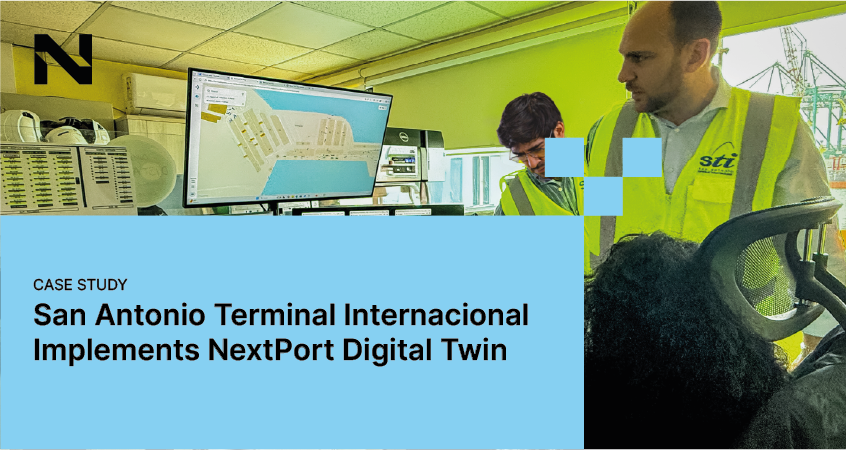
San Antonio Terminal Internacional Implements NextPort

San Antonio Terminal Internacional Implements NextPort

San Antonio Terminal Internacional (STI) in Chile has implemented a new digital operations platform in partnership with NextPort, aimed at enhancing visibility and efficiency across the terminal.

The digital twin is a virtual, real-time representation of terminal operations.

It enables online visualization of activities across the equipment fleet — including terminal tractors, container handlers, and STS and RTG cranes — supporting improved situational awareness, performance monitoring and operational decision-making.

All terminal equipment is fitted with the Black Dog card, a telemetry device developed in-house by STI’s Reliability team. The system enables the real-time transmission of operational data to a central platform, supporting both operations and maintenance planning.

The expanded use of telemetry is also expected to support more sustainable operations.

By optimizing transport routes and reducing fuel consumption and equipment wear, the platform has the potential to lower emissions and contribute to a reduced carbon footprint.

‍

Photo Courtesy of San Antonio Terminal Internacional

‍

Read More
How NextPort is Helping Monitor Carbon Costs in European Ports

How NextPort is Helping Monitor Carbon Costs in European Ports

NextPort provides the digital twin and data platform powering the EU-ETS Observatory’s analysis of how carbon costs are affecting shipping routes, cargo flows, and port competitiveness across Europe.

The European Union Emissions Trading System (EU-ETS) Observatory, which monitors how carbon costs are affecting maritime transport and port competitiveness, has released its second report tracking activity at EU gateway ports. As the consortium's digital twin and technology partner, NextPort develops and operates the data platform that powers the analysis.

Among its findings, the report shows that the share of long-haul transport work handled by major European Union gateway ports declined from 67% to 57% between Q1 2023 and Q1 2026, reinforcing the need to monitor potential shifts in cargo flows and port activity.

The EU-ETS is convened by Puertos del Estado, the Spanish government agency for state owned Spanish ports. This latest report measures the influence these costs have on shipping routes, port calls, cargo flows, and flags potential traffic diversion from European Union ports to nearby non-European Union hubs.

The report extends the analysis period to March 2026 and adds container-level tracking, helping the Observatory see where cargo moves after reaching European and nearby non-European ports. This makes it easier to identify changes in port choice, transshipment activity and feeder connections.

The Observatory is an initiative of Puertos del Estado, developed with Shipping Business Consultant (SBC), the Centre for Transport Innovation (CENIT) and NextPort.

The platform combines vessel tracking, port-call information, emissions data and shipping service intelligence. With container-level data, it can connect vessel movements with cargo movements, helping analysts identify rerouting, weaker connectivity and possible traffic gains for non-European Union hubs.

For NextPort, the report shows how digital technology can turn operational, emissions and container data into practical evidence to help authorities assess the European Union Emissions Trading System, protect port competitiveness and respond early to unintended network shifts.

‍

Read More

Ready to See NextPort in Action?

Discover how NXP Ports and NXP Terminals empower your team with collective intelligence-driven solutions. See how we combine data and human expertise for better trouble shooting and smarter decision-making.

Request a Demo