Drive innovation, advance technology, and create a lasting impact on the future of global connectivity and supply chains.
Expanding Team
NextPort now has 40 experts, growing 107% in just one year.
Innovation-Focused
Work with experts driving change through AI and digital twin technologies.
Impactful Careers
Join a fast-growing company shaping global supply chains.
Be the Future
Create a lasting impact in the field of maritime technology.
Meet NextPort
Our Mission
At NextPort, we aim to revolutionize maritime operations by delivering innovative, data-driven solutions to complex, logistical challenges. By harnessing the power of collective intelligence and predictive analytics, we strive to reduce emissions, support better decision-making, and foster smarter, more sustainable ports.
Our Solutions
We specialize in providing advanced products like NXP Ports and NXP Terminals that optimize:
Port Call Processes through predictive analytics and collective intelligence.
Landside congestion management by leveraging existing systems such as PCS, PMS, and AIS. Our solutions ensure seamless integration, enabling Just-In-Time operations for improved productivity and environmental sustainability.
Core Values
Innovation: Pioneering transformative technologies to redefine industry standards.
Collaboration: Partnering with port authorities, terminal operators, and supply chain stakeholders to drive progress and produce meaningful outcomes.
Sustainability: Designing solutions to optimize operational efficiency while reducing environmental impact.
Our Impact
Recognized by Thetius as one of 2024’s "50 Most Innovative Startups in Maritime".
Successful implementation of our Digital Twin product through projects such as:
Ports 4.0: Validated at the Ports of Algeciras, Santander, and Huelva.
SAFARI Project: Enhancing climate resilience at the Ports of Seville, Dunkirk, and Lisbon.
How We Hire
Getting to Know Each Other
The first step of our hiring process focuses on mutual understanding. You’ll learn about the role, and we’ll ask you to share your story.
Technical Evaluation
Applicants will complete structured assessments to showcase their technical expertise and problem-solving capabilities.
Meet the Team
The final stage of the process includes a team meeting to discuss your role in detail. After a consideration of all stages, the process concludes with an offer.
Why NextPort
"It has been a pleasure collaborating on the pilot and adoption of the Digital Twin solution, and on building a reliable and efficient data backbone to support it. This is a strong first step, and I look forward to the next phase focused on impact assessment and value realization through deep integration with processes and technology."
"I would like to acknowledge the outstanding work of the NextPort team, whose strong commitment, technical expertise, and consistent support were instrumental to the successful delivery of the project."
“What motivates me every day at work is knowing that what we build contributes to making terminals greener. Beyond the technology, the best part of my job is interacting with customers; listening to their needs, understanding their challenges, and working together to turn ideas into real, sustainable solutions. Those conversations are where innovation really starts.”
"I am really excited about the technologies being used here, as they align perfectly with my interests. On top of that, the team is full of talented and motivated professionals, making it a great environment to learn and grow while also contributing. Being part of a young and dynamic team makes the experience even more engaging and rewarding."
"I’m here for two reasons: an incredible team and a truly innovative product. That combination makes every day exciting and full of possibilities."
"NextPort offers the unique opportunity to contribute to the development of a product that addresses the daily challenges faced by professionals in the Ports environment. We take advantage of cutting-edge technologies and the latest in Artificial Intelligence to offer innovative solutions. Additionally, NextPort fosters a collaborative environment where our team, makes the journey of creating advanced products rewarding and engaging."
Join NextPort — Shape the Future of Ports!
Drive innovation, advance technology, and create a lasting impact on the future of global connectivity and supply chains.
How NextPort is Helping Monitor Carbon Costs in European Ports
August 3, 2026
August 4, 2026
NextPort provides the digital twin and data platform powering the EU-ETS Observatory’s analysis of how carbon costs are affecting shipping routes, cargo flows, and port competitiveness across Europe.
The European Union Emissions Trading System (EU-ETS) Observatory, which monitors how carbon costs are affecting maritime transport and port competitiveness, has released its second report tracking activity at EU gateway ports. As the consortium's digital twin and technology partner, NextPort develops and operates the data platform that powers the analysis.
Among its findings, the report shows that the share of long-haul transport work handled by major European Union gateway ports declined from 67% to 57% between Q1 2023 and Q1 2026, reinforcing the need to monitor potential shifts in cargo flows and port activity.
The EU-ETS is convened by Puertos del Estado, the Spanish government agency for state owned Spanish ports. This latest report measures the influence these costs have on shipping routes, port calls, cargo flows, and flags potential traffic diversion from European Union ports to nearby non-European Union hubs.
The report extends the analysis period to March 2026 and adds container-level tracking, helping the Observatory see where cargo moves after reaching European and nearby non-European ports. This makes it easier to identify changes in port choice, transshipment activity and feeder connections.
The Observatory is an initiative of Puertos del Estado, developed with Shipping Business Consultant (SBC), the Centre for Transport Innovation (CENIT) and NextPort.
The platform combines vessel tracking, port-call information, emissions data and shipping service intelligence. With container-level data, it can connect vessel movements with cargo movements, helping analysts identify rerouting, weaker connectivity and possible traffic gains for non-European Union hubs.
For NextPort, the report shows how digital technology can turn operational, emissions and container data into practical evidence to help authorities assess the European Union Emissions Trading System, protect port competitiveness and respond early to unintended network shifts.
Is the data you collect telling you what you need to know? At the recent TOC Europe conference, Chema Real Valero presented on how a data backbone is key to operational intelligence.
Terminals generate massive amounts of data every second. TOS events, crane telemetry, truck positioning, maintenance alerts, weather feeds, vessel AIS, gate transactions, equipment status and so on.
In this Big Data era, without careful management, control rooms are at risk of information overload: having access to vast amounts of data, without it giving them useful insights to improve operations. If that data is not structured in the right way for the terminal, there’s a risk it won’t give a true picture of on-the-ground operations.
Many terminals still operate across fragmented systems that capture only partial views of the reality of each movement. Each of these systems records operational events using different formats, timestamps, and levels of detail, which makes it difficult to align them into a consistent view. Siloed data sources don’t present a full picture of operational performance. Instead, each platform tells its own version of the operation:
• The TOS says the move is completed
• Telemetry says the truck is waiting
• Maintenance reports a crane issue
• The control room sees congestion building up.
When these signals are not harmonized, reconstructing the full operational story becomes complex and time-consuming. This creates two risks for terminals: first, there is a huge, missed opportunity to use that data to gain an accurate picture of movements to improve operations. Second, teams don’t trust or see the value that digitalization can deliver in terms of heightened operational intelligence, because it’s not useful to them.
Industry has recently improved how it organizes data through modern layered architectures such as Medallion, where information is progressively cleaned, structured, and prepared for operational use. Data operational sources are now more structured, while the information delivered to control rooms benefits from stronger analytics and a more robust foundation.
However, this data doesn’t translate to meet the immediate needs of a live terminal, where there are synchronized operational flows happening in real time across machines, systems, people, and infrastructure. Well organized data is the first step, but then these data flows need to be connected in order to see and understand how operations unfold across the terminal in real time.
So, how can data be better managed and organized to be more useful in day-to-day operational management?
The role of data backbone
Individual data sources need to be well organized, but they then need to be brought together to reconstruct a real-time business process. This is where the concept of a Data Backbone becomes critical.
At NextPort, we see the data backbone as the operational layer that connects isolated execution signals into a trusted picture of a movement, which creates a structured and standardized representation of how operational processes actually happen.
The role of the data backbone is to:
• Centralize operational data sources
• Harmonize execution signals
• Reconstruct the full container move across systems
• Contextualize events in real time
• Create the foundation for orchestration, continuous improvement, digital twins, and AI
• Align planning data with execution events to enable full traceability across the operation.
This data structure creates a live operational model of the terminal, which replicates how operations behave in real time. It also links planned activities with actual execution, creating a continuous feedback loop between expectation and reality.
This is important because when terminals can reconstruct operational reality end-to-end, they move beyond reactive operations.
They can:
• Identify bottlenecks faster
• Understand root causes of problems
• Compare planning vs execution
• Improve control room decision-making
• Optimize equipment coordination
• Reduce idle time and emissions
• Enable AI-driven operational support
• Continuously improve planning by learning.
By providing this structured and traceable view, the data backbone enables more adaptive and context-aware decision-making, where operations can adjust dynamically to real-time conditions such as congestion, delays, or equipment availability.
All of the technological potential for terminals in the form of advanced digital twins, AI-assisted operations, smart process orchestration, and predictive flow management depends on having consistent, harmonized, and traceable datasets. AI models, automation systems, and simulation engines rely on a true representation of operations to perform effectively.
More than a technical implementation, establishing a data backbone represents a strategic step towards enabling intelligent, data-driven terminal operations. Building a single operational source of reliable data — an on-the-ground operational truth — will be a defining factor in the success of future terminals.
San Antonio Terminal Internacional Implements NextPort
July 30, 2026
February 27, 2026
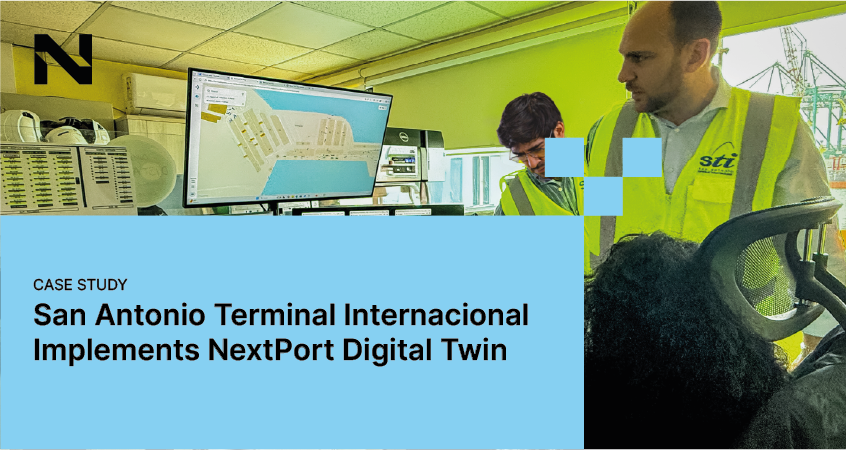
San Antonio Terminal Internacional (STI) in Chile has implemented a new digital operations platform in partnership with NextPort, aimed at enhancing visibility and efficiency across the terminal.
The digital twin is a virtual, real-time representation of terminal operations.
It enables online visualization of activities across the equipment fleet — including terminal tractors, container handlers, and STS and RTG cranes — supporting improved situational awareness, performance monitoring and operational decision-making.
All terminal equipment is fitted with the Black Dog card, a telemetry device developed in-house by STI’s Reliability team. The system enables the real-time transmission of operational data to a central platform, supporting both operations and maintenance planning.
The expanded use of telemetry is also expected to support more sustainable operations.
By optimizing transport routes and reducing fuel consumption and equipment wear, the platform has the potential to lower emissions and contribute to a reduced carbon footprint.