Optimizing Port Call Processes with Digital Twins & AI: The Port of Huelva
NXP Insight
|
December 2, 2025
November 11, 2025
|
5 Min Read
|
NextPort
Smart Digital Ports of the Future Europe 2025 returns to Amsterdam on 12–13 November for its 9th edition, a practitioner-led forum where advanced ports compare results, align on standards, and stress-test systems for scalability.
The conference agenda is framed around four interlocking themes: digital decarbonization, resiliency and agility, PCS and digital tools, and digital transformation. Each theme incorporates the overarching mandate of converting shared architectures and metrics into standardized frameworks or operational blueprints. At the conference, NextPort, in collaboration with the Port Authority of Huelva, will showcase how they've collaborated to turn fragmented information silos into coordinated action across the port call lifecycle.
The Port of Huelva project illustrates why interoperability matters. A FIWARE-aligned ecosystem and data-sharing culture allows an intelligence layer to seamlessly integrate without displacing incumbent systems, ensuring that insights land in the right workflow in time to change outcomes. Additionally, specific dashboards streamline the path from visibility to action. Some examples would be when arrival vessel draft exceeds the berth availability both on arrival or departure, DWT exceeds berth limits according to the local port compliance, vessel moves out of the port with a visit not properly finished or risk because two big vessels will cross in the navigation channel. Because unplanned disruptions are captured as first-class events, the digital twin learns from how port staff resolve those issues. This closes the loop between prediction and execution, thereby improving performance and making gains that translate directly into better resource utilization and lower operational disruptions.
Underpinning this capability is a Port Info strategy, which is a coordinated method to consolidate infrastructure data (zones, bathymetry, approach constraints), metocean signals, local regulations, planned services, and operational records into a unified, machine-readable baseline. When grounded in international standards, such as IHO S-100 and recent alignments across IMO FAL, ISO, and Maritime Single Windows, Port Info turns static charts and scatters into interoperable datasets that are directly usable in operations, lowering the barrier to adoption across port facilities. This alignment enables control room operators to spend less time hunting for facts, and more time acting on validated intelligence.
Only with a precise understanding of the port call process based on data, can you be effective in optimizing coordination and planning at arrival and departure. This means being able to build the track-record of each port call based on data that is actually fragmented across multiple systems or simply not in place. That’s why, at NextPort, we put effort into generating data on pilotage, towage and bunkering, ensuring that the information for each vessel, including conditions, is recorded.
Ángel Martínez Cavero, Product Adoption Manager, Ports, at NextPort
From this standpoint, we see the initial steps towards optimization as:
(1) Transparency and visibility across stakeholders: this means the shipping line, ship agent and terminal can leverage the Port Authority’s ecosystem. For example, not only having at ETA at PBP, but also deviation on that ETA at specific points of time, distance or service unavailability.
(2) Actionable awareness: these are issues where each stakeholder can take action, for example restrictions from sea-level and tides and the knock-on implications on draft conditions or berth suitability, or crossing vessels generating agitation hence mooring stress at specific berths.
(3) Optimize by anticipating disruptions or by learning from past occurrences: at ports, many of the contingency situations are not properly instrumented or registered for learning purposes, for example how to incorporate a congestion or metocean condition into operations.
FIWARE as our reference architecture lets us federate data across stakeholders and allow partners such as NextPort to deliver event-driven insights as well as to add an operational intelligence layer on top of our infrastructure, enhancing situational awareness and enabling proactive port-call coordination.
Manuel Francisco Martínez Torres, Chief Technology Officer at Port Authority of Huelva
Industry consensus is moving towards this way of thinking. As highlighted in the 2025 PCO Plenary discussions, Port Call Optimization (PCO) has progressed from proof of concept to operational reality, but scaling requires shared standards and structured data across ship, shore, and sea. However, a practical maturity path is emerging that allows us to achieve this ambition. First, we must institute common Port Call events to establish shared situational awareness; second, enrich vessel particulars for stronger feasibility checks; and third, integrate real-time and forecasted metocean to improve predictability. The result is next-generation PCO, that fuses Port Info with Digital Twins and AI to deliver proactive recommendations and event-driven coordination across stakeholders.
These elements map directly to SDP 2025 key topics. For digital decarbonization, the digital twins expose avoidable emissions embedded in waiting time and identify inefficient sequences. For resiliency and agility, short-horizon predictors surface conflict before it happens, such as weather windows, resource clashes, or agitation-driven mooring stress, so plans can pivot without cascading delays. Looking ahead, the goal is to shorten the interval between sensing, deciding, and execution, so that coordination becomes proactive by default. In Amsterdam, we will share insights from Huelva to make the approach more concrete and reusable. For ports pursuing SDP 2025’s themes, an event-centric, standards-aligned digital twin provides the most direct route from data to operational advantage, offering a portable intelligence layer that seamlessly integrates into your port community ecosystem to improve safety and predictability and measurably advance efficiency, sustainability, and resilience.
At NextPort, our vision is to make ports data-driven by default. We fuse Port Infrastructure, metocean data, vessel state, and marine services into an operational twin, then deliver prescriptive insight to people and systems through governed event streams. Fully interoperable with PCS/TOS/PMS/GIS (incl. FIWARE-aligned interfaces), our platform augments, but does not replace, your stack, which works to improve safety, predictability and efficiency, while laying a measurable path to decarbonization and resilience.
Thank you! Your submission has been received!
Oops! Something went wrong while submitting the form.
More News & Events
NextPort Achieves Key Information Security Certification
News
|
September 24, 2026
September 24, 2026
We are pleased to announce that we have successfully We are pleased to announce that we have successfully achieved ISO 27001, across NextPort's offices in Valencia and Algeciras, Spain, as well as our parent company Moffatt & Nichol's Long Beach and Raleigh offices in the United States., across NextPort's offices in Valencia and Algeciras, Spain, as well as our parent company Moffatt & Nichol's Long Beach and Raleigh offices in the United States.
This is the internationally recognised standard for an Information Security Management System (ISMS). It sets out the requirements for how an organisation should identify, manage, and reduce risks related to information and data security.
This certification reinforces our commitment to maintaining the highest standards of information security, governance, and continuous improvement.
It reflects the hard work of colleagues across the business and our commitment to earning and maintaining the trust of those we work with every day.
San Antonio Terminal Internacional Implements NextPort
News
|
August 18, 2026
February 27, 2026
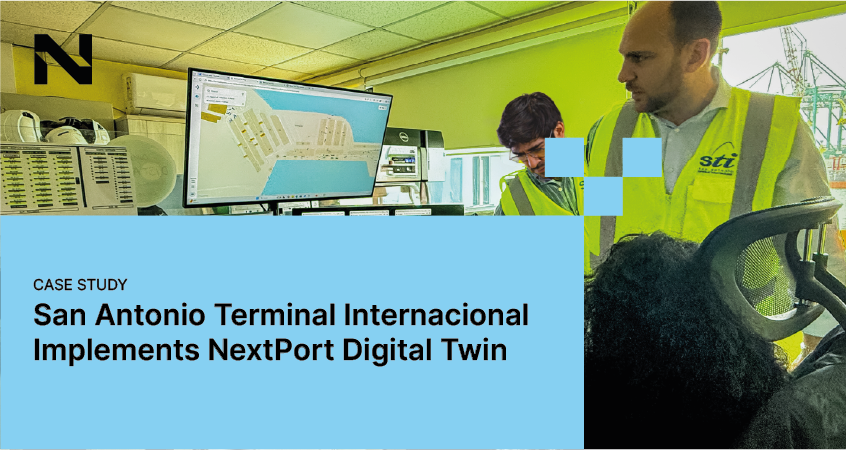
San Antonio Terminal Internacional (STI) in Chile has implemented a new digital operations platform in partnership with NextPort, aimed at enhancing visibility and efficiency across the terminal.
The digital twin is a virtual, real-time representation of terminal operations.
It enables online visualization of activities across the equipment fleet — including terminal tractors, container handlers, and STS and RTG cranes — supporting improved situational awareness, performance monitoring and operational decision-making.
All terminal equipment is fitted with the Black Dog card, a telemetry device developed in-house by STI’s Reliability team. The system enables the real-time transmission of operational data to a central platform, supporting both operations and maintenance planning.
The expanded use of telemetry is also expected to support more sustainable operations.
By optimizing transport routes and reducing fuel consumption and equipment wear, the platform has the potential to lower emissions and contribute to a reduced carbon footprint.
Photo Courtesy of San Antonio Terminal Internacional
How NextPort is Helping Monitor Carbon Costs in European Ports
News
|
August 4, 2026
August 4, 2026
NextPort provides the digital twin and data platform powering the EU-ETS Observatory’s analysis of how carbon costs are affecting shipping routes, cargo flows, and port competitiveness across Europe.
The European Union Emissions Trading System (EU-ETS) Observatory, which monitors how carbon costs are affecting maritime transport and port competitiveness, has released its second report tracking activity at EU gateway ports. As the consortium's digital twin and technology partner, NextPort develops and operates the data platform that powers the analysis.
Among its findings, the report shows that the share of long-haul transport work handled by major European Union gateway ports declined from 67% to 57% between Q1 2023 and Q1 2026, reinforcing the need to monitor potential shifts in cargo flows and port activity.
The EU-ETS is convened by Puertos del Estado, the Spanish government agency for state owned Spanish ports. This latest report measures the influence these costs have on shipping routes, port calls, cargo flows, and flags potential traffic diversion from European Union ports to nearby non-European Union hubs.
The report extends the analysis period to March 2026 and adds container-level tracking, helping the Observatory see where cargo moves after reaching European and nearby non-European ports. This makes it easier to identify changes in port choice, transshipment activity and feeder connections.
The Observatory is an initiative of Puertos del Estado, developed with Shipping Business Consultant (SBC), the Centre for Transport Innovation (CENIT) and NextPort.
The platform combines vessel tracking, port-call information, emissions data and shipping service intelligence. With container-level data, it can connect vessel movements with cargo movements, helping analysts identify rerouting, weaker connectivity and possible traffic gains for non-European Union hubs.
For NextPort, the report shows how digital technology can turn operational, emissions and container data into practical evidence to help authorities assess the European Union Emissions Trading System, protect port competitiveness and respond early to unintended network shifts.
Discover how NXP Ports and NXP Terminals empower your team with collective intelligence-driven solutions. See how we combine data and human expertise for better trouble shooting and smarter decision-making.
"It has been a pleasure collaborating on the pilot and adoption of the Digital Twin solution, and on building a reliable and efficient data backbone to support it. This is a strong first step, and I look forward to the next phase focused on impact assessment and value realization through deep integration with processes and technology."
"I would like to acknowledge the outstanding work of the NextPort team, whose strong commitment, technical expertise, and consistent support were instrumental to the successful delivery of the project."
“What motivates me every day at work is knowing that what we build contributes to making terminals greener. Beyond the technology, the best part of my job is interacting with customers; listening to their needs, understanding their challenges, and working together to turn ideas into real, sustainable solutions. Those conversations are where innovation really starts.”
"I am really excited about the technologies being used here, as they align perfectly with my interests. On top of that, the team is full of talented and motivated professionals, making it a great environment to learn and grow while also contributing. Being part of a young and dynamic team makes the experience even more engaging and rewarding."
"I’m here for two reasons: an incredible team and a truly innovative product. That combination makes every day exciting and full of possibilities."
"NextPort offers the unique opportunity to contribute to the development of a product that addresses the daily challenges faced by professionals in the Ports environment. We take advantage of cutting-edge technologies and the latest in Artificial Intelligence to offer innovative solutions. Additionally, NextPort fosters a collaborative environment where our team, makes the journey of creating advanced products rewarding and engaging."