NextPort becomes an International Taskforce Port Call Optimization endorsing organization
News
|
May 21, 2025
May 5, 2025
|
2 Min Read
|
Moffatt & Nichol
Moffatt & Nichol has become an official endorsing organization for the International Taskforce Port Call Optimization (ITPCO), an internationally recognized and neutral working group that has developed standards for ship to shore information exchange.
The endorsement extends to Moffatt & Nichol’s operational digital twin company, NextPort. NextPort’s technology solution for ports and terminals brings together previously siloed information and standardizes it to the Terminal Industry Committee, TIC 4.0, initiative. Through this collated data, the software is not only able to troubleshoot immediate operational problems, but gather long term data to enable operational improvements at a strategic level.
The aim of ITPCO is to reduce and optimize vessel berth time at ports. It’s advancing best practice globally by moving from a siloed approach where there’s improvement at just one port, to working at a strategic level to bring about a sustained improvement.
Miluše Tichavska, Green Ports Director at Moffatt & Nichol, said: “Global supply chains are complex systems which rely on transparency and collaboration to keep moving. By endorsing the International Taskforce Port Call Optimization (ITPCO), we hope to support the industry as it works as one to increase efficiency.”
Dr. Oscar Pernia, Chief Technology Officer at NextPort, said: “Our technology connects information across metocean, vessel schedules and positions, and marine operations events. Endorsing ITPCO is key enabler for interoperability across systems, and we are active contributors to adoption of its standard data models and API.”
Captain Ben van Scherpenzeel. ITPCO Chairman, said: “ITPCO welcomes parties who harmonize their solutions with the IMO and IHO standards as an endorser of ITPCO.”
Oops! Something went wrong while submitting the form.
More News & Events
San Antonio Terminal Internacional Implements NextPort
News
|
July 21, 2026
February 27, 2026
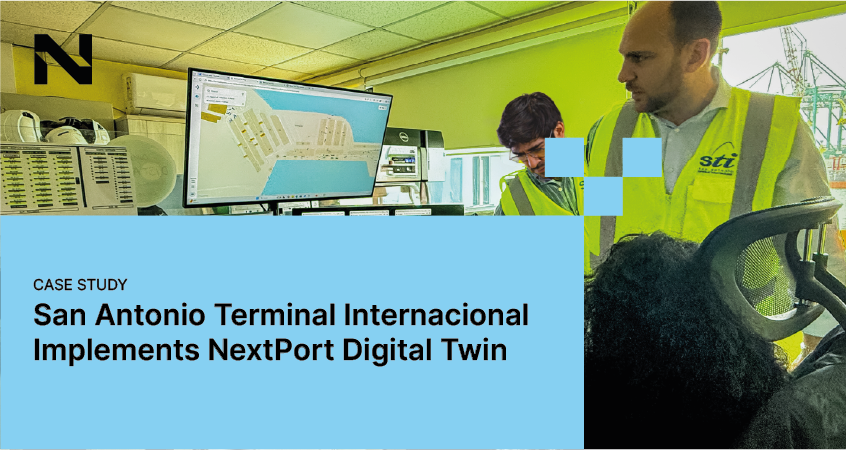
San Antonio Terminal Internacional (STI) in Chile has implemented a new digital operations platform in partnership with NextPort, aimed at enhancing visibility and efficiency across the terminal.
The digital twin is a virtual, real-time representation of terminal operations.
It enables online visualization of activities across the equipment fleet — including terminal tractors, container handlers, and STS and RTG cranes — supporting improved situational awareness, performance monitoring and operational decision-making.
All terminal equipment is fitted with the Black Dog card, a telemetry device developed in-house by STI’s Reliability team. The system enables the real-time transmission of operational data to a central platform, supporting both operations and maintenance planning.
The expanded use of telemetry is also expected to support more sustainable operations.
By optimizing transport routes and reducing fuel consumption and equipment wear, the platform has the potential to lower emissions and contribute to a reduced carbon footprint.
Is the data you collect telling you what you need to know? At the recent TOC Europe conference, Chema Real Valero presented on how a data backbone is key to operational intelligence.
Terminals generate massive amounts of data every second. TOS events, crane telemetry, truck positioning, maintenance alerts, weather feeds, vessel AIS, gate transactions, equipment status and so on.
In this Big Data era, without careful management, control rooms are at risk of information overload: having access to vast amounts of data, without it giving them useful insights to improve operations. If that data is not structured in the right way for the terminal, there’s a risk it won’t give a true picture of on-the-ground operations.
Many terminals still operate across fragmented systems that capture only partial views of the reality of each movement. Each of these systems records operational events using different formats, timestamps, and levels of detail, which makes it difficult to align them into a consistent view. Siloed data sources don’t present a full picture of operational performance. Instead, each platform tells its own version of the operation:
• The TOS says the move is completed
• Telemetry says the truck is waiting
• Maintenance reports a crane issue
• The control room sees congestion building up.
When these signals are not harmonized, reconstructing the full operational story becomes complex and time-consuming. This creates two risks for terminals: first, there is a huge, missed opportunity to use that data to gain an accurate picture of movements to improve operations. Second, teams don’t trust or see the value that digitalization can deliver in terms of heightened operational intelligence, because it’s not useful to them.
Industry has recently improved how it organizes data through modern layered architectures such as Medallion, where information is progressively cleaned, structured, and prepared for operational use. Data operational sources are now more structured, while the information delivered to control rooms benefits from stronger analytics and a more robust foundation.
However, this data doesn’t translate to meet the immediate needs of a live terminal, where there are synchronized operational flows happening in real time across machines, systems, people, and infrastructure. Well organized data is the first step, but then these data flows need to be connected in order to see and understand how operations unfold across the terminal in real time.
So, how can data be better managed and organized to be more useful in day-to-day operational management?
The role of data backbone
Individual data sources need to be well organized, but they then need to be brought together to reconstruct a real-time business process. This is where the concept of a Data Backbone becomes critical.
At NextPort, we see the data backbone as the operational layer that connects isolated execution signals into a trusted picture of a movement, which creates a structured and standardized representation of how operational processes actually happen.
The role of the data backbone is to:
• Centralize operational data sources
• Harmonize execution signals
• Reconstruct the full container move across systems
• Contextualize events in real time
• Create the foundation for orchestration, continuous improvement, digital twins, and AI
• Align planning data with execution events to enable full traceability across the operation.
This data structure creates a live operational model of the terminal, which replicates how operations behave in real time. It also links planned activities with actual execution, creating a continuous feedback loop between expectation and reality.
This is important because when terminals can reconstruct operational reality end-to-end, they move beyond reactive operations.
They can:
• Identify bottlenecks faster
• Understand root causes of problems
• Compare planning vs execution
• Improve control room decision-making
• Optimize equipment coordination
• Reduce idle time and emissions
• Enable AI-driven operational support
• Continuously improve planning by learning.
By providing this structured and traceable view, the data backbone enables more adaptive and context-aware decision-making, where operations can adjust dynamically to real-time conditions such as congestion, delays, or equipment availability.
All of the technological potential for terminals in the form of advanced digital twins, AI-assisted operations, smart process orchestration, and predictive flow management depends on having consistent, harmonized, and traceable datasets. AI models, automation systems, and simulation engines rely on a true representation of operations to perform effectively.
More than a technical implementation, establishing a data backbone represents a strategic step towards enabling intelligent, data-driven terminal operations. Building a single operational source of reliable data — an on-the-ground operational truth — will be a defining factor in the success of future terminals.
An initiative to improve port resilience using NextPort’s digital twin technology has received a prestigious award for digital innovation.
The SAFARI project (Safe, ClimAte Resilient Infrastructure) was recognized as an award winning initiative in the category ‘Application of Emerging Technologies in the Port Sector.’ It was presented at the SOCINFO Digital Awards, where the award was received jointly with the project partners: the Port Authority of Seville, Sener, the University of Seville and Todobarro, highlighting the collaborative nature of the initiative.
The SOCINFO Digital Awards recognize digital transformation projects that deliver tangible impact across public administrations and strategic sectors. For the 2026 awards, special emphasis was placed on TIC Ports (Puertos TIC), recognizing organizations that are driving the digital transformation of the port sector through advanced technologies such as digital platforms, digital twins, artificial intelligence, automation and energy efficient solutions.
Funded by the Horizon Europe program, the SAFARI project aims to strengthen the resilience of port infrastructure by integrating advanced technologies and adopting a data driven approach. The project focuses on improving the capacity of port environments to anticipate, respond to and recover from climate related and operational risks, supporting safer and more resilient infrastructure management.
Oscar Pernia, Chief Technology Officer at NextPort said: “Digital twins are increasingly applied to multiple domains in ports. Their applications supports ports in optimizing their resources and assets, as well as further ensuring safe navigation and logistic resiliency, particularly in the context of a changing climate. NextPort's developments with Port of Sevilla and Sener in this area are key. Congratulations to the SAFARI team on this accolade, reflecting the collaboration and expertise that has gone into the project and the beneficial outcomes already being realized.”
At the Port of Seville, SAFARI is being implemented through the development of a comprehensive digital ecosystem that brings together a digital twin of infrastructure and operations, with real time data integration, predictive models and early warning systems, and advanced sensor networks. NextPort is responsible for developing the digital twin for SAFARI project, conceived as a unified platform that integrates information from vessels, infrastructure, port operations, services, ocean meteorological conditions and regulatory frameworks. NextPort’s digital twin acts as an integration and intelligence layer, connecting processes, systems and people, and transforming information generated by the platform into actionable alerts and operational context.
Discover how NXP Ports and NXP Terminals empower your team with collective intelligence-driven solutions. See how we combine data and human expertise for better trouble shooting and smarter decision-making.
"It has been a pleasure collaborating on the pilot and adoption of the Digital Twin solution, and on building a reliable and efficient data backbone to support it. This is a strong first step, and I look forward to the next phase focused on impact assessment and value realization through deep integration with processes and technology."
"I would like to acknowledge the outstanding work of the NextPort team, whose strong commitment, technical expertise, and consistent support were instrumental to the successful delivery of the project."
“What motivates me every day at work is knowing that what we build contributes to making terminals greener. Beyond the technology, the best part of my job is interacting with customers; listening to their needs, understanding their challenges, and working together to turn ideas into real, sustainable solutions. Those conversations are where innovation really starts.”
"I am really excited about the technologies being used here, as they align perfectly with my interests. On top of that, the team is full of talented and motivated professionals, making it a great environment to learn and grow while also contributing. Being part of a young and dynamic team makes the experience even more engaging and rewarding."
"I’m here for two reasons: an incredible team and a truly innovative product. That combination makes every day exciting and full of possibilities."
"NextPort offers the unique opportunity to contribute to the development of a product that addresses the daily challenges faced by professionals in the Ports environment. We take advantage of cutting-edge technologies and the latest in Artificial Intelligence to offer innovative solutions. Additionally, NextPort fosters a collaborative environment where our team, makes the journey of creating advanced products rewarding and engaging."